












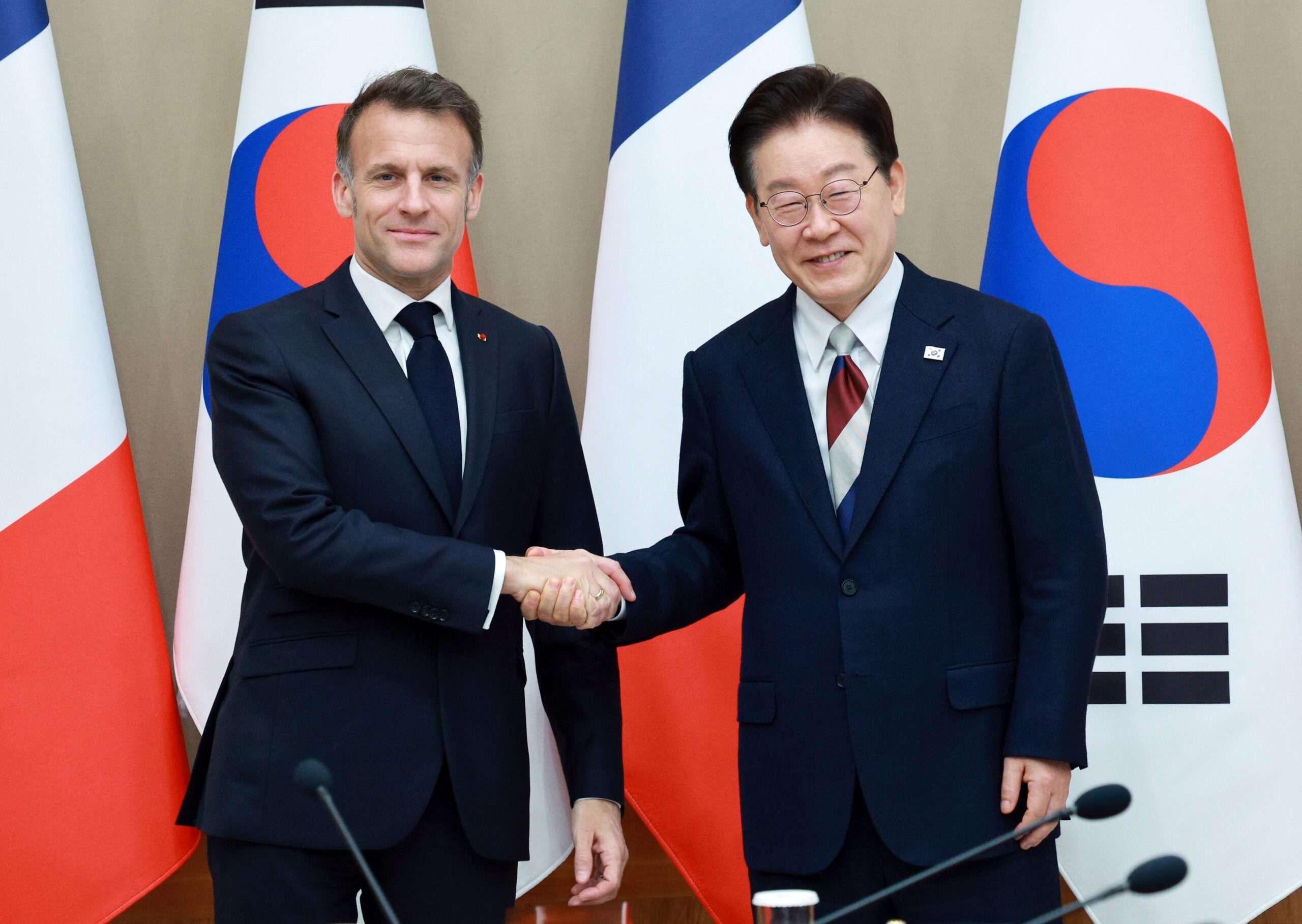
South Korean President Lee Jae Myung said Friday he and French President Emmanuel Macron agreed to work together to secure the safe passage through the Strait of Hormuz and mitigate the broad impact from the war in the Middle East. Lee addressed concerns over uncertainties in global energy supply chains following summit talks with Macron, during which the two leaders discussed ways to deepen economic ties and strengthen coordination on security issues. “President Macron and I agreed to share policy-related experiences and strategies in order to jointly address the economic and energy crisis triggered by the Middle East war. We also concurred on working together to reduce uncertainty in the global economy,” Lee said during a joint press announcement.
“We confirmed our commitment to bolstering energy security by expanding our cooperation in the nuclear and offshore wind power sectors while collaborating to secure safe maritime transport routes through the Strait of Hormuz,” he added. Macron also underscored the need for France and South Korea to cooperate to help reopen the Strait of Hormuz and deescalate conflict in the Middle East at the international level, Yonhap news agency reported. Lee said the two leaders also agreed to boost trade and investment with a goal of reaching $20 billion in annual bilateral trade by 2030, up from $15 billion last year. To boost cooperation across sectors, the two sides signed a series of memorandums of understanding (MOUs) and other documents. They pledged to expand cooperation in advanced technologies and future industries — including artificial intelligence, semiconductors and quantum technology — and to establish a ministerial-level joint committee on science and technology. The two countries also signed a letter of intent on cooperation in critical mineral supply chains, aimed at combining South Korea’s manufacturing capabilities with France’s processing technology and infrastructure. The state-run Korea Hydro and Nuclear Power signed MOUs with French nuclear firms, Orano and Framatome, as well as a separate MOU with France’s EDF on a joint development of an offshore wind power plant in the southwestern city of Yeonggwang. Lee expressed hope that the agreements would ensure a stable supply of raw materials for South Korea’s nuclear power plants and lay the groundwork for joint entry into the global market. He also laid out plans to cooperate in space and defence while pledging efforts to bolster collaboration in the cultural sector in light of an MOU signed between the two nations’ cultural heritage agencies. During the talks, Lee said he explained Seoul’s efforts to resume dialogue with Pyongyang to promote peace on the Korean Peninsula, while Macron reaffirmed Paris’ support for peace and stability on the peninsula.
“We two leaders shared a profound understanding that peace on the Korean Peninsula has far reaching implications not just in Northeast Asia and Europe but also the rest of the world,” Lee said. Lee noted that Seoul and Paris have expanded cooperation across a wide range of sectors, including future strategic industries, such as artificial intelligence, quantum technology, space, nuclear energy and defense, and expressed hope to deepen coordination on the international stage. “As responsible members of the international community, the two countries are also working together to respond to rapid changes in the global landscape,” he said. Lee said Macron extended a formal invitation to the Group of Seven summit scheduled for June in Evian, France, adding that he accepted the invitation. If he attends, it would mark his second consecutive appearance at the G7, following his participation in Canada last year.

