













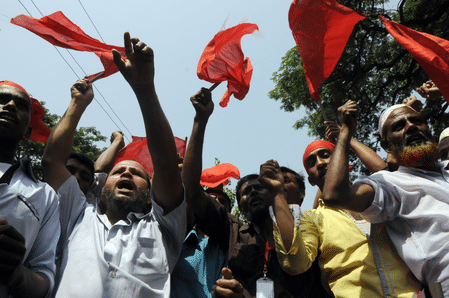
Thousands of garment workers across Bangladesh continued protests on November 25, 2026, after a government-appointed wage board approved a 36% increase in the industry’s minimum monthly wage to 17,000 taka (US$138), marking the smallest percentage increase in four decades. The decision has failed to ease weeks of labour unrest that have reportedly resulted in $428 million in production losses and disrupted international supply chains for major retailers, including H&M, Zara, Walmart and Gap.
Following a 12-hour negotiation session, the Minimum Wage Board voted 4–2 to increase the minimum monthly salary by 4,500 taka from the previous rate of 12,500 taka, established in 2023. Under the revised four-grade wage structure, monthly salaries will range from 17,000 taka for entry-level Grade 4 workers to 21,500 taka for Grade 1 employees. The new wage structure will take effect on December 1, 2026, with workers expected to receive their first revised salaries in January 2027.
Garment workers had initially demanded a minimum monthly wage of between 30,000 and 32,000 taka, citing rising food, housing, transportation and healthcare costs. Union representatives subsequently lowered their negotiating demand to 18,000 taka, which factory owners rejected. The approved minimum wage falls approximately 43% below the workers’ initial demand of 30,000 taka and 5.6% below the unions’ final negotiating position.
Thousands of workers resumed demonstrations in major industrial hubs, including Gazipur, blocking highways and disrupting manufacturing operations. Police deployed tear gas and sound grenades to disperse protesters. According to the Bangladesh Garment Manufacturers and Exporters Association (BGMEA), 18 days of disruptions affecting 317 factories have resulted in an estimated $428 million in production losses, equivalent to nearly $24 million per day. Approximately $254 million in international apparel orders have reportedly been redirected to competing manufacturing countries. On Tuesday alone, nearly 400 factories were unable to operate, while more than 80 were closed under no-work, no-pay provisions.
Bangladesh is one of the world’s largest garment exporters, ranking behind China among leading apparel-exporting countries. The ready-made garment industry employs approximately four million workers, a substantial proportion of whom are women, and accounts for more than 80% of the country’s merchandise export earnings. The sector generates tens of billions of dollars in annual export revenue, making it a critical source of foreign exchange, employment and economic growth.
Bangladesh’s garment industry has historically maintained its international competitiveness through relatively low labour costs. The sector’s minimum monthly wage increased from 3,000 taka in 2010 to 5,300 taka in 2013, 8,000 taka in 2018 and 12,500 taka in 2023. The latest 36% increase is considerably smaller than the 56.25% increase approved in 2023 and the approximately 51% increase implemented in 2018. Workers argue that rising living costs have significantly eroded the purchasing power of previous wage increases.
Factory owners have warned that higher labour costs could weaken Bangladesh’s competitiveness against other garment-producing economies, including India, Vietnam, Indonesia and Pakistan. Industry representatives have urged international fashion brands to increase purchasing prices to help manufacturers absorb additional wage expenses without reducing employment or compromising their financial viability.
Meanwhile, labour rights organizations, including the Clean Clothes Campaign, have criticized international retailers for failing to explicitly support higher living wages or commit to adjusting supplier prices to cover increased labour costs. Some union representatives nevertheless acknowledged that securing a wage revision after three years, rather than the traditional five-year cycle, represented partial progress.
The ongoing unrest highlights the challenges facing Bangladesh’s export-dependent economy as it seeks to balance industrial competitiveness with workers’ demands for higher living standards. Prolonged disruptions could accelerate the diversion of international orders to competing manufacturing destinations, including India and Vietnam, while placing additional pressure on Bangladesh’s export revenues, foreign exchange reserves and employment. The dispute also raises broader questions about the responsibility of global fashion retailers in ensuring fair wages across their international supply chains.

