











By Ramona Singh (Associate Editor – Y Media)
A 46-year reign ended in Milton. A sitting mayor finished third in Hamilton. And in Mississauga, two former mayors spent a campaign fighting each other while a third candidate walked off with the job. Ontario’s municipal election night delivered something for everyone: comfortable re-elections, stunning upsets and a handful of pollsters who will want to forget the whole thing. This was not a province-wide revolt.
Voters returned incumbent mayors in Toronto, Brampton, Markham, Ottawa, Vaughan, Richmond Hill and Greater Sudbury. But in Mississauga, Hamilton, Milton, Oakville, Niagara Falls, Halton Hills, Clarington, Bradford West Gwillimbury and West Nipissing, they showed long-serving leaders the door.
The pattern was not party or region. It was a community-by-community verdict on whether City Hall was still listening. Where residents felt it was, experience was an asset. Where they felt it wasn’t, a long résumé became a target.
The issues were familiar: property taxes, the pace of development, public safety and accountability. The answers were anything but uniform.
Toronto: Chow gets her own mandate
In 2023, Olivia Chow won a byelection to fill a sudden vacancy. This time, Torontonians were grading her record, and they gave her a passing mark.
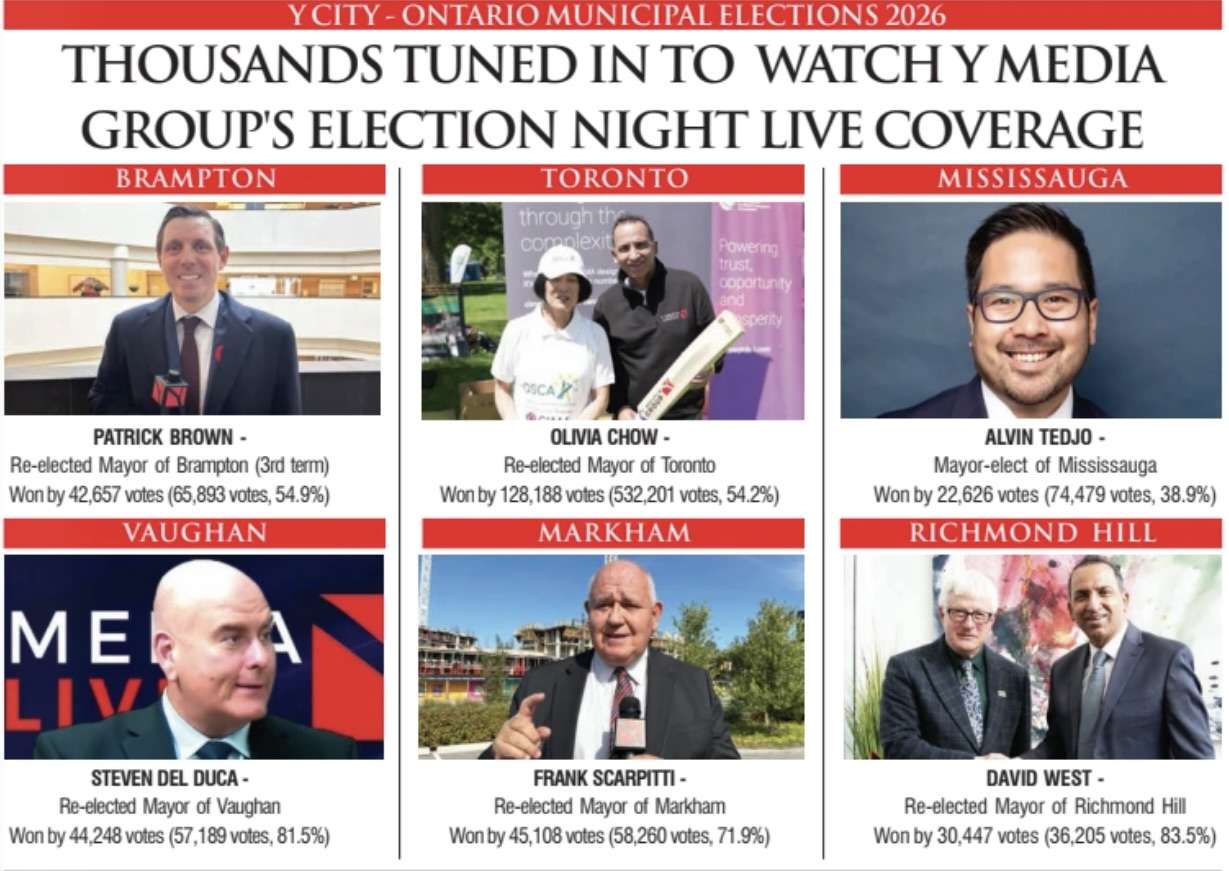
Chow took 54.2 per cent of the vote to Brad Bradford’s 41.2 per cent, a margin of roughly 13 points and more than 125,000 votes. It is her first full four-year term.
The race was a clean clash of philosophies. Bradford offered a residential property-tax freeze, the removal of the land-transfer tax for qualifying buyers, a 25 per cent cut to water bills and 1,000 more frontline police officers. He also pitched subway platform-edge doors, fare refunds for delays of 15 minutes or more and a full audit of city finances.
Chow countered that a freeze would eventually mean cutting services. She promised tax increases at or near inflation, another year of frozen TTC fares, weekly fare capping after ten rides and incentives for 10,000 purpose-built rental homes, some below market rent. Voters chose protecting services over freezing taxes.
The drama ran deeper down the ballot. Three sitting councillors lost. Chiara Padovani unseated Frances Nunziata, who had represented York South–Weston since 1997 and once served as mayor of the former City of York. Curran Stikuts beat Chris Moise in Toronto Centre, 28.6 per cent to 23.4. Former MP Shaun Chen defeated TTC chair Jamaal Myers in Scarborough North by more than 10 points.
Familiar faces filled the open seats. Mike Layton returns in University–Rosedale. Former federal MP Nathaniel Erskine-Smith takes Bradford’s old Beaches–East York seat. Diana Chan McNally wins Parkdale–High Park and Sara Ehrhardt takes Toronto–Danforth.
Chow now has a mandate, but no party caucus. Every major vote will still be a negotiation, and the TTC needs a new chair.
Mississauga: while two mayors fought, Tedjo won
For months, Mississauga’s race was billed as a heavyweight rematch: incumbent Carolyn Parrish against former mayor Bonnie Crombie. Then the votes were counted, and neither of them won.
Alvin Tedjo took 74,479 votes, about 39.2 per cent. Parrish finished second at 27.3 per cent. Crombie, who led the final published poll, came third at 22.7 per cent. Tedjo’s margin over Parrish topped 22,600 votes.
Tedjo, the runner-up in the 2024 byelection, ran as the generational alternative to both. His headline promise was a two-year freeze on the city-controlled portion of residential property taxes.
That excludes the Peel Region and education portions of the bill. He also pledged an operations review, a seniors’ tax rebate of about $700 for eligible low-income residents, expanded transit and a return of the mayor to the Peel Police Service Board, a seat Parrish had given up.
Parrish ran on continuity, spending control and finishing the projects from her shorter term. Crombie pitched herself as the experienced city builder. But as their rivalry dominated the headlines, Tedjo became the choice for voters tired of both.
Council changes too. Natalie Hart wins Ward 5, and Tom Ellard takes Tedjo’s former Ward 2 seat.
Now comes the hard part: keeping services intact while holding the city’s share of taxes flat.
Brampton: Brown cruises, but most stayed home
Patrick Brown didn’t just win a third term. He won more votes than his three closest challengers combined.
Brown took 65,893 votes, or 54.9 per cent. Wesley Jackson was a distant second at 19.4 per cent, followed by Prabh Gill at 12.7 and Jagruti Bhatt at 5.3. The gap between first and second: 42,657 votes.
Brown ran on affordability, safety, infrastructure and growth, promising to press on with his “Big Brampton Build” while keeping taxes and fees in check. Jackson campaigned on financial oversight and a review of city procurement. Gill offered a six-part plan spanning affordability, safety, transportation, healthcare advocacy, the economy and transparency.
The asterisk is turnout: about 28.8 per cent. Fewer than three in ten eligible residents chose the city’s leadership.
Wards 9 and 10: the 286-vote thriller
Below the mayor’s chair, Brampton’s real nail-biter was the open Wards 9 and 10 regional seat. Nine candidates chased the job left by Gurpartap Singh Toor, the youngest Councillor in the city’s history, who did not seek re-election.
Sukhman Sangha, a 28-year-old lawyer and former Ontario government policy adviser, won with 7,406 votes, or 25.24 per cent. Former two-term Councillor Gurpreet Singh Dhillon was right behind with 7,120, or 24.26 per cent. Out of 29,345 votes cast, just 286 separated them, the narrowest margin in any of Brampton’s ten council races.
Further back in the nine-candidate field, Michael Dancy took 4,124 votes, Satpaul Singh Johal 3,228 and Gregory Miller 2,531. Nirmala Devi Madhu, Harsimran Singh, Gurpreet K. Dhillon and Prabhjot Singh Dhaliwal each finished below 2,000.
Dhillon represented the wards from 2014 to 2022 and was trying to reclaim the seat he lost four years ago. His comeback carried baggage. During his second term he faced allegations of sexual misconduct, which he denies and he and Mayor Brown have fought publicly over them for years. On the trail, Dhillon pitched affordability, public safety, accountability and better transit.
Then there was the ballot itself. A second candidate with almost the same name, Gurpreet K. Dhillon, ran in the same race and drew 1,171 votes, or 3.99 per cent, about four times the gap between first and second. Whether any of those ballots were cast by mistake is impossible to know. But with two Gurpreet Dhillons listed side by side, it is a footnote neither camp will forget.
The results remain unofficial, and no recount has been announced.
The rest of council
Taran Chahal took the open Wards 7 and 8 city seat with 6,573 votes, 2,159 ahead of Monica Singh Soares. Rod Power, who vacated that seat, won the Wards 7 and 8 regional race with about 53.6 per cent. Harkirat Singh held the Wards 9 and 10 city seat with 8,393 votes, or 29 per cent. The fight for second there was even tighter than the regional race: Azad Goyat edged Janice Gordon-Daniels by just nine votes, 5,282 to 5,273.
In the school board races covering the same wards, Khushpal Singh Pawar won the Peel District School Board seat for Wards 9 and 10 with 6,354 votes, well ahead of Harsimran Singh at 3,953. Andrea Baranowski took the Dufferin-Peel Catholic seat for Wards 7 to 10 with 2,345 votes, or 41.5 per cent, ahead of Shawn Xaviour at 1,948 and Karen Dancy at 1,363.
All Brampton figures are from the City of Brampton’s unofficial results, with all 164 voting locations reporting.
Most incumbents held on, including Paul Vicente, Michael Palleschi, Martin Medeiros, Rowena Santos, Navjit Kaur Brar, Dennis Keenan and Harkirat Singh.
Three eras end in Halton and Hamilton
Milton: the end of the Krantz years
Gord Krantz became Milton’s mayor in 1980. Pierre Trudeau was prime minister. The town had a fraction of today’s population. On election night, his 46-year run came to an end.
George Minakakis won with 20,262 votes, or 45.2 per cent. Krantz took about 25.4 per cent and Zainab Azim 13.8. The margin was roughly 8,900 votes.
Minakakis ran on modernization: tackling congestion, long-term financial planning, and making sure jobs, schools and healthcare keep pace with growth. Krantz stood on stability and restrained taxes. Milton showed up to decide. Turnout neared 39 per cent, about 10 points higher than in 2022, and advance voting more than doubled.
The council is new too. Owen Gray, Patrick Murphy and Giles Vanderholt won open seats, Adil Khalqi held Ward 3, and Rick Di Lorenzo unseated regional councillor Sammy Ijaz.
Oakville: the insider who ran for change
Jeff Knoll spent 26 years on Oakville council. This time he ran against the mayor he served alongside, and won.
Knoll took 36.3 per cent. Sean O’Meara finished second at 22.5. Five-term mayor Rob Burton came third at 20.4, with Julia Hanna at 17.7. Knoll’s margin over O’Meara topped 8,000 votes.
The defining fight was Midtown Oakville. Knoll opposed the province’s density framework, promising to seek the cancellation of four ministerial zoning orders and restore the town’s own Official Plan Amendment 70. He also pledged a lobbyist registry, an internal auditor, four-year budgets and opposition to hyperscale AI data centres.
Turnout climbed to about 34.3 per cent, up from 28.3 in 2022. Six newcomers join council: Alexandra Caldwell, Stacey Saunders, Morgan Elliott, Roger Lapworth, Audrey Wubbenhorst and Mackenzie Grant.
Hamilton: Loomis completes his comeback
Four years ago, Keanin Loomis lost to Andrea Horwath by 1,663 votes. This time it wasn’t close.
Loomis won about 41.8 per cent. Councillor Rob Cooper placed second at 31.9. Horwath, the incumbent and former Ontario NDP leader, finished a distant third at 14.5 per cent.
Loomis’s signature promise is zero-based budgeting, where every department justifies its spending from scratch each year. He also pledged to co-ordinate road and utility work, and to build up to 5,000 affordable homes through partnerships. Horwath ran on nearly $1 billion secured from other governments and about 2,100 affordable or supportive homes built or under construction.
Turnout slipped to about 31.6 per cent from 35.4 in 2022. Several council incumbents also fell, with Dawn Danko winning Ward 8 and Rick Kunc taking Ward 13.
The upset tour, from the Falls to the north
The big cities grabbed the headlines, but some of the night’s sharpest swings came in smaller communities.
Niagara Falls. Lori Lococo unseated longtime mayor Jim Diodati, 51.6 per cent to 41.7. Tourism, development and infrastructure now pass to a new administration in one of Canada’s best-known cities.
Halton Hills. Jason Brass routed incumbent Ann Lawlor, 55.7 per cent to 30.3, a 25-point margin. Growth pressure on farmland and community character will dominate his term.
Clarington. Tom Dingwall ended Adrian Foster’s four-term run, 53.1 per cent to 46.9, in one of Durham Region’s fastest-growing municipalities.
Bradford West Gwillimbury. This was the night’s strangest result. Nickolas Harper won with 4,579 votes, just 350 ahead of Peter Ferragine. Incumbent James Leduc, who led the only published poll, finished fifth with 1,497 votes. Harper promised to hand strong-mayor budget powers back to council, restore the old budget process, extend traffic calming and press Simcoe County to relocate its temporary asylum centre.
West Nipissing. Yvon Duhaime defeated incumbent Kathleen Thorne Rochon with 64.4 per cent, a margin of 2,212 votes. One council race there was settled by four votes. Anyone who thinks a single ballot doesn’t matter should take a drive north.
The survivors
Not every incumbent was in trouble. In several cities, voters kept the mayor and shook up the council around them.
Greater Sudbury re-elected Paul Lefebvre with 63.6 per cent, more than 14,700 votes ahead of Miranda Rocca-Circelli. Yet five new councillors won in Wards 8 through 12, and Glen Duffy and Marcel Montpellier unseated incumbents in Wards 2 and 3.
Markham returned Frank Scarpitti with about 72 per cent. Kenneth Li won the open Ward 6 seat, and Amanda Yeung Collucci moved up to regional council.
Ottawa, Vaughan and Richmond Hill stayed the course, re-electing Mark Sutcliffe, Steven Del Duca and David West.
Cambridge went the other way, electing Scott Hamilton with about 56.8 per cent, its third new mayor in three elections. Turnout was just 27 per cent, and Mark Linton won Ward 2 by 29 votes.
Now the real work begins
Winning was the easy part. Ontario’s mayors don’t command party caucuses. Even with strong-mayor powers, they need council votes to pass budgets and deliver programs, and many of the new mayors will face councillors who served under the leaders they just defeated.
Tedjo must freeze taxes without gutting services. Loomis must make every department justify its budget without starting a civil war at City Hall. Minakakis must lead a town that has known only one mayor for nearly half a century.
The results remain unofficial until certified by municipal clerks. New councils begin their four-year terms in November. The campaigns are over; the bills come due next.