













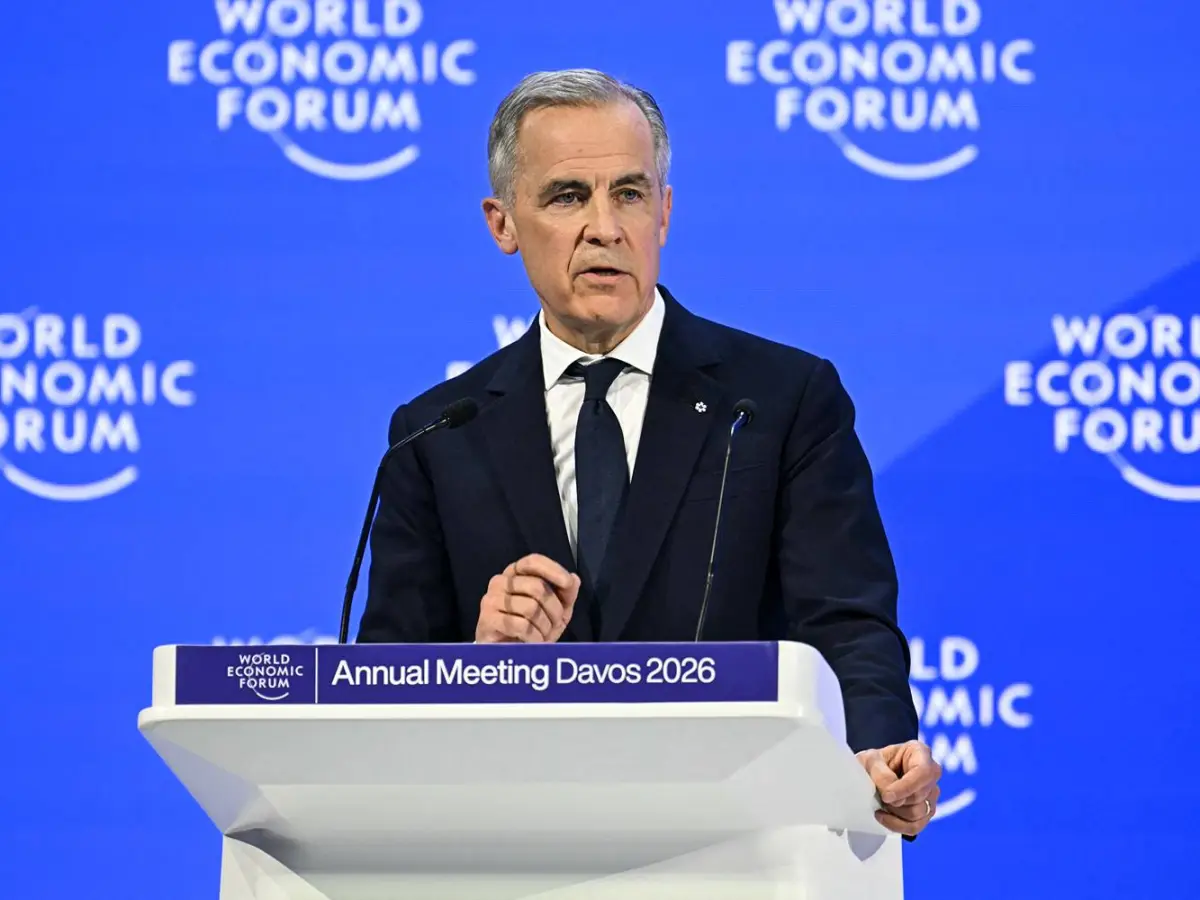
Prime Minister Mark Carney has called for a deeper economic and strategic partnership between Canada and the European Union, arguing that closer cooperation could strengthen sovereignty, economic resilience and security on both sides of the Atlantic.
Addressing the European Parliament in Strasbourg, France, on Thursday, Carney outlined a vision for greater Canada-EU cooperation in areas including artificial intelligence, critical minerals, defence, energy security, space and financial services. He said the objective was not for Canada and Europe to become completely self-sufficient, but to develop greater “collective resilience” at a time when trade, supply chains and financial systems are increasingly being used as instruments of geopolitical pressure.
Carney told European lawmakers that Canada and Europe possess complementary economic and strategic strengths. Europe brings significant market power, research capacity and advanced manufacturing, while Canada has substantial energy and critical mineral resources as well as expertise in artificial intelligence, quantum technology, space and financial services. “Canada and Europe are each strong. Europe and Canada are stronger together,” he said.
The prime minister also stressed that he was not proposing the creation of another geopolitical power bloc to compete with major global powers. Instead, he said the proposed partnership would be designed to protect open markets, sovereignty, territorial integrity, democratic institutions and the rule of law. Carney argued that closer cooperation between Canada and Europe could contribute to what he described as a more just, stable and prosperous international order.
The speech comes as Canada and the EU consider expanding their relationship beyond the Comprehensive Economic and Trade Agreement, or CETA. European Commission President Ursula von der Leyen has proposed opening discussions on Canada potentially becoming the EU’s first “associate member.” Such a membership category does not currently exist under EU treaties, making the precise structure and implications of the proposal still unclear.
Carney welcomed the broader ambition behind von der Leyen’s proposal, describing an “alliance for the future” as an opportunity for Canada and Europe to build on their shared interests and complementary capabilities. His proposals included closer digital trade, cooperation on critical-mineral supply chains, expanded energy links, joint work on artificial intelligence standards and stronger opportunities for young Canadians and Europeans to live, study and work across the Atlantic.
The initiative has also drawn criticism from U.S. President Donald Trump. Trump said Wednesday that Canada becoming an EU associate member could be viewed as a “hostile act” depending on the intentions behind the arrangement and warned that the United States could impose heavy tariffs on Europe. He also criticized Canada’s record as a U.S. trading partner.
Carney, however, said the effort to deepen relations with Europe should be viewed as a positive initiative rather than simply a response to tensions with Washington. The prime minister has framed diversification of Canada’s international partnerships as a means of strengthening the country’s strategic autonomy and reducing vulnerabilities in critical sectors. The federal government said Thursday that a more integrated Canada-EU partnership could provide greater security, economic opportunity and prosperity on both sides of the Atlantic.
Carney concluded his European Parliament address by portraying the proposed partnership as one built around shared principles rather than opposition to another country or bloc. He said Canada and Europe should pursue an alliance centred on freedom, solidarity, prosperity and sustainability while ensuring that both retain the ability to make their own sovereign choices.

