











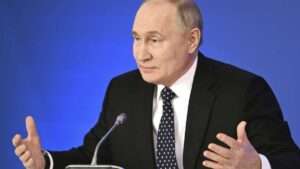
President Vladimir Putin’s United Russia party has retained overwhelming control of Russia’s parliament, securing a record 355 of the 450 seats in the State Duma in the country’s first parliamentary election since its full-scale invasion of Ukraine began in 2022.
With more than 95 per cent of ballots counted, United Russia received about 57.8 per cent of the party-list vote, according to Russia’s Central Election Commission. That represents an increase from the 49.8 per cent the party received in the 2021 parliamentary election and leaves it with the constitutional majority needed to pass legislation and constitutional amendments without support from other parties.
The Communist Party finished second with about 13.8 per cent, followed by the Liberal Democratic Party at roughly nine per cent and New People at about eight per cent. A Just Russia also secured representation. The parties represented in the new parliament have generally supported the Kremlin on major policies, including the war in Ukraine.
The election took place over three days from September 18 to 20 in a tightly controlled political environment. Most prominent Kremlin opponents are imprisoned, in exile or otherwise excluded from national politics, while anti-war candidates faced significant restrictions. Yabloko, Russia’s only registered party openly opposing the war, failed to secure national representation, although it gained a small foothold in the Novgorod regional parliament.
Putin had presented the election as an opportunity for Russians to demonstrate national unity during the war. The Kremlin is likely to point to United Russia’s increased vote share and parliamentary majority as evidence of support for its policies, although analysts caution against treating the official result as a straightforward measurement of public opinion because of restrictions on opposition activity, independent media and election monitoring.
Official turnout was reported at about 59.3 per cent of roughly 111 million eligible voters. Opposition activists alleged electoral violations, while Russian election authorities maintained that the voting process was legitimate. International scrutiny has also focused on the absence of independent observers and restrictions affecting political competition.
Voting was also conducted in Russian-occupied areas of Ukraine, including Crimea and parts of Donetsk, Luhansk, Kherson and Zaporizhzhia. Ukraine rejects the votes held in those territories as illegal, while France on Monday condemned the election environment and the organization of voting in occupied Ukrainian territory.
The election unfolded against the backdrop of continuing warfare. A major Ukrainian drone assault targeted Moscow and other Russian regions during the final stages of voting, underscoring how the conflict has increasingly reached Russian territory.
Despite United Russia’s commanding victory, some analysts are watching support for other parties for signs of dissatisfaction over the economic and social consequences of the war. Because the Communist Party, New People and other parliamentary parties largely operate within Russia’s Kremlin-approved political system, however, votes for them cannot automatically be interpreted as direct opposition to Putin or the war.
The preliminary outcome nevertheless leaves the basic balance of political power in Moscow unchanged: United Russia remains firmly in control of the State Duma, giving Putin a supportive legislature as the war in Ukraine continues and Russia faces sustained international sanctions and domestic economic pressures.

