













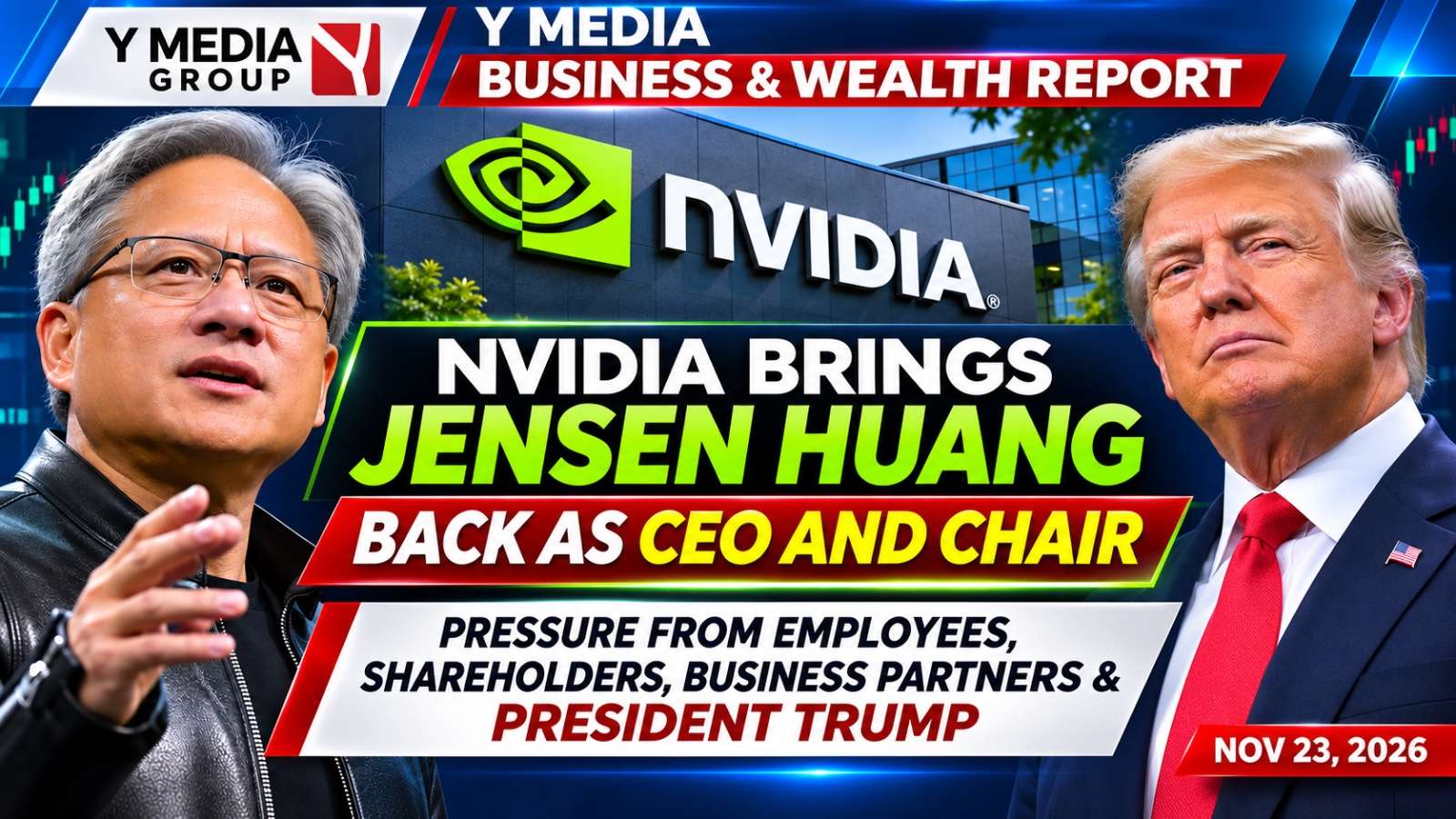
Nvidia’s board of directors has reinstated co-founder Jensen Huang as president, chief executive officer and board director following intervention by U.S. President Donald Trump, reversing his departure less than two weeks earlier amid allegations of extramarital affairs and potential Chinese intelligence connections. The November 23, 2026, announcement sent Nvidia shares soaring as much as 33 per cent, adding approximately $900 billion to its market valuation and triggering a broader rally in artificial intelligence stocks following a severe market selloff.
The controversy centres on Huang’s reported relationship with Alice Huang, a former executive at Singapore-based AI infrastructure company Megaspeed International, which has been investigated by U.S. authorities over suspected exports of restricted Nvidia semiconductors to China. The national security implications intensified on November 22 when The New York Times reported that Alice Huang had maintained contact with an official from China’s Ministry of State Security between spring 2025 and autumn 2026, overlapping with her relationship with the Nvidia chief executive.
The latest intelligence reporting raised questions about whether Chinese authorities had attempted to gain access to sensitive information about American semiconductor technology and export controls. However, U.S. authorities have not publicly concluded that Alice Huang engaged in espionage or that Jensen Huang knowingly compromised national security. The Justice Department’s investigation remains ongoing.
According to a timeline compiled by Reuters, Jensen Huang and Alice Huang were photographed together during Taiwan’s Computex technology conference in June 2024 and attended a private dinner in Taipei in May 2025. Reports about their relationship and Megaspeed’s activities subsequently attracted attention from U.S. intelligence officials. In spring 2026, Secretary of State Marco Rubio reportedly oversaw the preparation of a classified memorandum warning senior administration officials about the relationship and its possible security implications.
The controversy also involved allegations of additional extramarital relationships within Nvidia. On November 11, The New York Times reported that Huang had an affair with Kimberly Powell, Nvidia’s vice-president of healthcare, who reported directly to him. Reuters subsequently reported on November 12 that Huang had also been involved with a second Nvidia employee whose identity was not publicly disclosed. The allegations raised concerns about corporate governance, executive accountability and potential conflicts of interest.
Huang acknowledged being unfaithful to his wife in a communication to Nvidia employees on November 8. Nvidia’s board subsequently launched an independent investigation into reports that its chief executive may have been targeted by a foreign intelligence operation. Huang resigned from his executive and board positions on November 12, and chief financial officer Colette Kress assumed the role of interim CEO.
The national security investigation extends beyond Huang’s personal relationships. U.S. authorities began examining Megaspeed’s activities in 2024 amid concerns that advanced Nvidia AI chips were being diverted to Chinese customers despite American export restrictions. Investigators requested Nvidia records in May 2025, and the company placed Megaspeed on an internal no-sell list in June 2025. American and Singaporean authorities subsequently examined the company’s operations, while the U.S. Justice Department assumed responsibility for a criminal investigation.
Megaspeed has maintained that it conducts legitimate business and announced that Alice Huang formally left the company on August 30, 2025. Singaporean authorities have said she departed Singapore in February 2026 and was subsequently barred from re-entering following an investigation unrelated to espionage. The allegations concerning Chinese intelligence contacts have not resulted in a publicly established finding that she acted as a spy.
The leadership crisis coincided with a dramatic decline in Nvidia’s market value. On November 12, the day Huang’s resignation became public, Nvidia shares fell as much as 14.3 per cent during trading before recovering to a decline of approximately 5.4 per cent. The selloff came as investors questioned whether the company’s AI expansion strategy could continue without its co-founder.
Despite the turmoil, Nvidia reported exceptionally strong financial results on November 17. Third-quarter revenue reached $115.8 billion, an increase of 103 per cent from the previous year, while data-centre revenue climbed 110 per cent to $107.6 billion. The company also projected approximately $130 billion in fourth-quarter revenue, exceeding market expectations. Nevertheless, the positive earnings report failed to reverse the broader decline in its shares.
On November 18, Nvidia stock fell another 2.9 per cent, leaving it approximately 36 per cent below its October record. By November 23, before the reinstatement announcement, the shares had declined roughly 43 per cent over the preceding month. The weakness reflected concerns about Huang’s departure, possible regulatory investigations, elevated AI valuations and uncertainty surrounding the industry’s massive infrastructure investments.
The selloff intensified during the week of November 16 to 20, as technology and AI-related companies suffered substantial losses amid concerns about financing costs, regulatory restrictions and whether enormous investments in artificial intelligence would generate sufficient returns. The downturn followed political uncertainty after the U.S. midterm elections, with investors assessing the possibility of tighter restrictions on data-centre construction and advanced semiconductor exports.
Nvidia’s financial relationships with AI infrastructure companies have also attracted scrutiny over so-called circular financing. Under such arrangements, Nvidia invests in or financially supports companies developing AI infrastructure, while those businesses use financing and capital commitments to purchase Nvidia chips. The model can accelerate demand for computing infrastructure but raises questions about how independently that demand is financed and whether investment commitments are sustainable.
Nvidia-backed cloud infrastructure companies, including CoreWeave and Nebius, have been particularly sensitive to concerns about AI spending and financing. On November 12, Nebius shares declined approximately 18 per cent after the company reduced its 2026 revenue forecast, while CoreWeave fell about 8.1 per cent. The movements demonstrated how uncertainty surrounding Nvidia could spread through companies dependent on its technology and the broader AI investment cycle.
Against this backdrop, President Trump repeatedly advocated Huang’s return. On November 16, Trump indicated that he would not object to reinstating the Nvidia co-founder, while supporters circulated a petition that attracted more than 177,000 signatures, including backing from prominent technology executives. Although Nvidia’s board initially ruled out rehiring Huang on November 17, its position changed following further discussions with Huang and senior U.S. government officials.
The board formally approved Huang’s reinstatement on November 22 and publicly announced the decision on November 23. Board Chair Harvey C. Jones said directors were satisfied with Huang’s candour and ability to lead the company. Following consultations with senior federal officials, the board stated that it was confident his reinstatement posed no national security risk. Kress will continue as chief financial officer, while Jones remains board chair.
Trump welcomed the decision, describing it as the correct course for Nvidia and the American economy. The president said the U.S. government had no reason to believe Huang’s return represented a national security threat and maintained that federal authorities had not established evidence of unlawful conduct by him. However, the White House’s support does not end the independent corporate investigation or ongoing regulatory inquiries.
Wall Street responded with a major rally on November 23. Nvidia shares opened at approximately $167.04, around 27 per cent above their previous closing price, and climbed more than 30 per cent during the morning session. Reuters reported gains reaching approximately 33 per cent, equivalent to roughly $900 billion in additional market capitalization.
The rebound extended across the technology sector. In premarket trading on November 23, CoreWeave gained approximately 33.4 per cent, Nebius rose 31.8 per cent, Micron Technology advanced 17.3 per cent, Taiwan Semiconductor Manufacturing Company climbed 14.9 per cent and Advanced Micro Devices increased 7.8 per cent. The broader Nasdaq Composite surged more than seven per cent during early trading, while the S&P 500 gained more than five per cent and the Dow Jones Industrial Average rose more than 1,500 points.
The rally marked a sharp reversal from the previous week’s losses, although it did not fully restore Nvidia’s earlier valuation. Analysts cautioned that the company continued to face questions about leadership oversight, China-related export controls, AI infrastructure financing and the sustainability of extraordinary capital spending across the technology industry.
Nvidia has announced additional corporate safeguards, including a National Security and Export Control Committee composed of independent directors and plans to recruit a chief compliance officer. An independent investigation into allegations of foreign intelligence targeting will continue, alongside government inquiries into possible export-control violations, accounting practices and corporate disclosures.
Huang also faces congressional scrutiny. House Foreign Affairs Committee Chairman Brian Mast, House Intelligence Committee Chairman Rick Crawford and House Select Committee on China Chairman John Moolenaar have sought answers about his relationship with Alice Huang and Nvidia’s security procedures. Huang has agreed to participate in transcribed interviews with three House committees on December 1, while Nvidia general counsel Tim Teter is scheduled to appear on December 2. A separate Senate hearing has been requested, although its date has not been finalized.
Huang’s return underscores Nvidia’s importance to the global artificial intelligence industry and the broader U.S.-China technological rivalry. While his reinstatement has produced a substantial recovery in investor confidence, the company remains under pressure to demonstrate that its governance procedures, export-control safeguards and AI financing relationships can withstand heightened regulatory scrutiny.

