













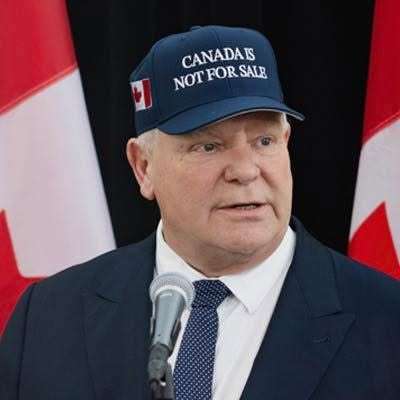
Ontario Premier Doug Ford has said he will not support a Canada–U.S. trade agreement unless Ontario’s automotive, steel and manufacturing industries endorse its terms, emphasizing that any agreement must protect Canadian jobs, industrial competitiveness and long-term economic growth.
Speaking on Monday, November 23, 2026, at an event hosted by the Toronto Region Board of Trade and the Calgary Chamber of Commerce, Ford said industry executives and labour representatives must be satisfied that their businesses can remain viable and expand under the proposed agreement. The premier reiterated that he would rather see negotiations conclude without a deal than accept terms that undermine Ontario’s manufacturing sector.
Ford revealed that he opposed a previous American proposal in August 2026 that would have reduced tariffs on Canadian automobiles and automotive parts from 25% to 15% without providing exemptions for goods compliant with the Canada–United States–Mexico Agreement (CUSMA). According to Ford, automakers, parts manufacturers and labour representatives warned that the proposed tariff structure would severely damage the Canadian automotive industry.
Ontario has significant economic exposure to American tariffs, with approximately 933,000 jobs, or one in nine jobs across the province, dependent on U.S. export demand. According to federal government figures, the United States accounted for approximately 72% of Ontario’s merchandise exports in 2025, down from 77% in 2024, while 46% of the province’s manufacturing sales were destined for the American market. feddev-ontario.canada.ca+1
Ontario exported $60 billion worth of automobiles and automotive parts to the United States in 2025, down from $62 billion in 2024, with the American market accounting for 96% of the province’s automotive exports. Ontario’s 2026 Fall Economic Statement reported that the automotive and steel industries employed more than 100,000 and 16,000 people, respectively, in 2025, in addition to thousands of workers across their supply chains. feddev-ontario.canada.ca+2
Although international trade negotiations fall under federal jurisdiction, provincial governments could influence the implementation of an agreement. Washington is seeking the reinstatement of American alcoholic beverages in provincial liquor stores and the removal of restrictions preventing American companies from bidding on provincial government contracts. Premiers previously resisted Prime Minister Mark Carney’s request to restore American alcohol sales ahead of the August negotiations.
Despite his conditions, Ford expressed optimism about reaching an agreement before the end of 2026. Alberta Premier Danielle Smith also suggested that President Donald Trump may seek to finalize negotiations before the incoming Democratic-controlled Congress takes office on January 3, 2027.
U.S. Trade Representative Jamieson Greer indicated on Sunday that negotiations were approaching an agreement. However, Canada’s chief negotiator, Janice Charette, reportedly informed the Prime Minister’s Advisory Committee on Canada–U.S. Economic Relations last week that several major trade disputes remained unresolved. Ottawa is pursuing an interim agreement to secure tariff relief before broader negotiations on the future of CUSMA. Global News+1
The stakes extend beyond Ontario. According to Statistics Canada, exports to the United States accounted for 15.9% of Canada’s GDP and supported more than 2.5 million Canadian jobs in 2024. The automotive industry alone contributed $16.8 billion to Canada’s GDP, directly employing more than 125,000 workers and indirectly supporting approximately 427,000 jobs nationwide. Statistics Canada+1
While both governments continue to pursue an agreement, Ford’s position underscores the pressure facing Ottawa to secure meaningful tariff relief without compromising the competitiveness of Canada’s industrial sector.

