













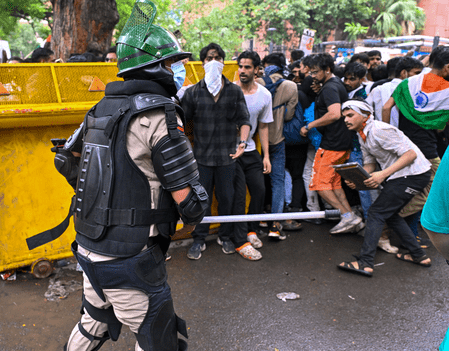
India’s Supreme Court has constituted a five-member High-Powered Expert Committee to investigate allegations of excessive police and security-force action during protests over the NEET paper leak, including claims of harassment, molestation and serious injuries suffered by demonstrators.
The committee will be headed by former Supreme Court judge Justice R. Subhash Reddy. Its other members are former Punjab and Haryana High Court Chief Justice Ravi Shankar Jha, former Delhi High Court judge Justice Shalinder Kaur, former CBI director Rishi Kumar Shukla and retired Meghalaya DGP L.R. Bishnoi.
A bench comprising Chief Justice Surya Kant and Justices Joymalya Bagchi and V. Mohana said the panel had been formed to conduct a comprehensive review of the allegations and provide recommendations to the court.
The court directed the committee to give priority to allegations of harassment and molestation, particularly those involving female protesters, and to examine cases in which demonstrators sustained serious or severe injuries during police action.
The inquiry will also examine allegations involving the use of pellet guns, electric batons, lathi-charges and tear gasby police, paramilitary forces and other security personnel.
Thousands of demonstrators, led by the Cockroach Janta Party, marched in Delhi on July 20, the opening day of Parliament’s Monsoon Session, demanding the resignation of Education Minister Dharmendra Pradhan over the NEET paper leak controversy.
Police used tear gas and batons to disperse protesters, leading to clashes and widespread detentions. The crackdown later became a major political issue, with opposition lawmakers repeatedly raising the matter after Parliament reconvened.
The Supreme Court has ordered authorities to preserve CCTV footage, drone recordings, body-camera footage and police control room call records connected to the demonstrations so that investigators can independently reconstruct the events and prevent evidence from being altered or destroyed.
The court also reiterated its earlier order directing the release of detained minors, except those accused of serious or heinous offences.
In addition, the bench instructed authorities to protect protesters’ personal information and barred police from publicly releasing private data belonging to demonstrators.
The court stressed that the committee’s work will not be limited to a one-time investigation. Instead, it will conduct continuous and periodic assessments and submit interim findings to the Supreme Court.
It also clarified that disciplinary proceedings against individual police officers do not have to wait for the committee’s final report. Competent authorities may independently initiate departmental action where warranted.
The panel’s findings are expected to help the Supreme Court determine whether security forces used disproportionate force during the NEET protests and whether additional safeguards are required to protect the rights and safety of peaceful demonstrators.

