













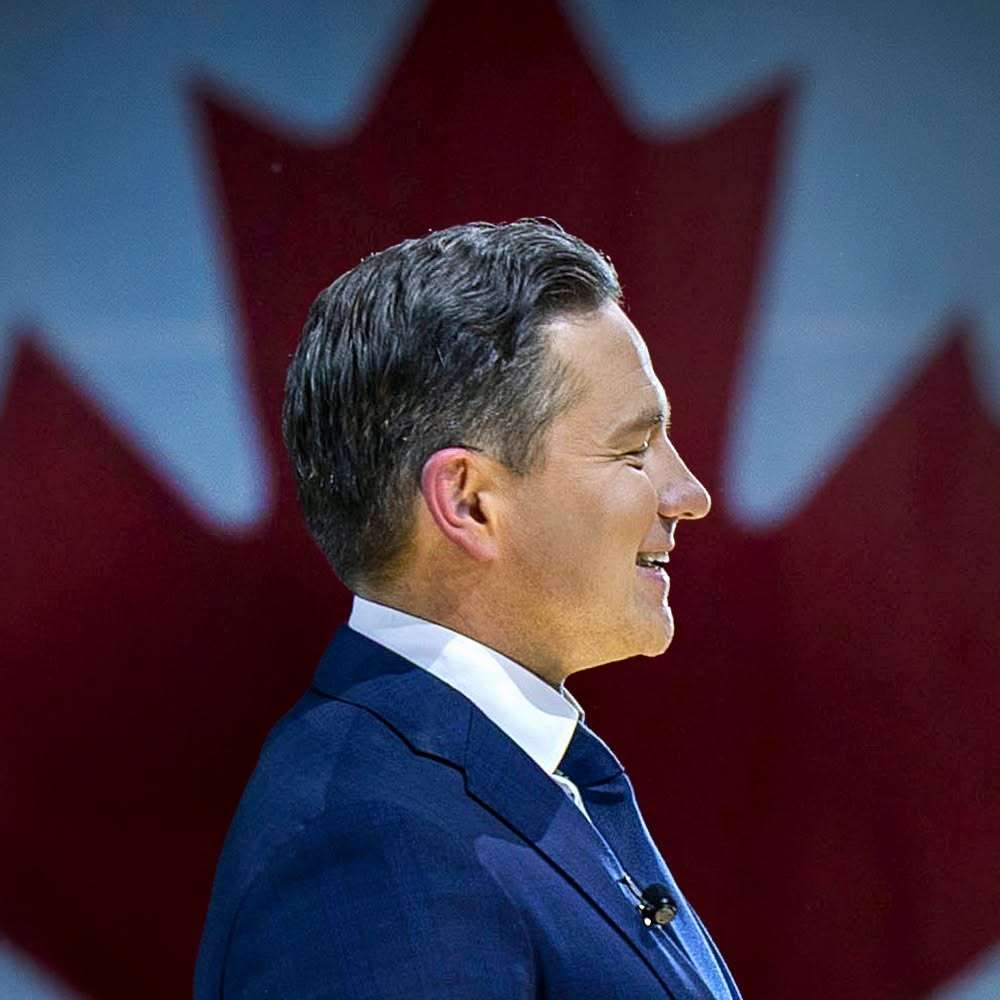
Conservative Leader Pierre Poilievre has invited Iran’s exiled former crown prince Reza Pahlavi to visit Canada, as Pahlavi seeks to position himself as a potential figure in a future democratic transition in Iran.
Poilievre announced the invitation during a “Persian Town Hall” in British Columbia on August 15, organized by the Conservative candidate in the upcoming North Vancouver—Capilano byelection. He also said he planned to speak virtually with Pahlavi, the son of Iran’s last Shah, who was overthrown during the 1979 Islamic Revolution.
Poilievre stopped short of endorsing Pahlavi as Iran’s future leader, saying it is not Canada’s role to determine who should govern the country.
“It is not the role of the Canadians or any foreign government to tell Iranians who should run their country, but there should be a free and democratic Iran that is in the hands of the Iranian people,” Poilievre told the gathering.
On Thursday, Poilievre posted a screenshot of a video call with Pahlavi, saying the two discussed the Iranian diaspora’s hopes for political change. The Conservative leader also argued that Canada should seize assets belonging to the Iranian regime and use them to support the Iranian people.
Pahlavi, 65, lives in the Washington area and has increasingly presented himself as a potential transitional leader who could oversee Iran’s move from the current Islamic Republic toward democratic elections.
His supporters view him as a recognizable figure capable of uniting opposition to the Iranian government. A petition tabled in the House of Commons this spring by former Ontario MPP Goldie Ghamari described Pahlavi as a “democratic, unifying, and nationally recognized leader” for a potential transition.
However, Pahlavi remains a divisive figure. Critics point to the authoritarian record of his father’s government and question whether the former crown prince has developed a viable political and governance structure during nearly five decades in exile.
Macdonald-Laurier Institute senior fellow Kaveh Shahrooz has also criticized Pahlavi’s approach to Iran’s ethnic and political diversity, arguing that his movement has failed to adequately address issues such as federalism and minority language rights.
Debate surrounding Pahlavi has intensified amid the ongoing conflict involving Iran, Israel and the United States. Iran is now led by Supreme Leader Mojtaba Khamenei, who succeeded his father, Ayatollah Ali Khamenei, following his death in March. Canada has designated Iran’s Islamic Revolutionary Guard Corps as a terrorist organization.
The federal government, meanwhile, has maintained that it will not endorse any individual Iranian opposition leader.
Earlier this year, a parliamentary petition called on Ottawa to recognize Pahlavi as the “legitimate representative of the Iranian people.” In response, Parliamentary Secretary Rob Oliphant said Canada supports the Iranian people’s struggle against repression but believes Iran’s political future must ultimately be decided by Iranians themselves.
Pahlavi has visited Toronto previously and participated in events organized by Iranian and Jewish groups.
The invitation also comes amid longstanding concerns about Iranian foreign interference and transnational repression in Canada. Iranian Canadians have reported threats and intimidation targeting critics of Tehran, including alleged pressure against their relatives in Iran.
Canada severed diplomatic relations with Iran in 2012. In its January 2025 final report, Canada’s foreign interference inquiry found that Iran uses transnational repression to discourage criticism of its government, including through criminal networks and online psychological harassment.
The issue has gained greater urgency following widespread anti-government demonstrations in Iran that began over economic hardship, water shortages and electricity disruptions before developing into broader calls for political change. Iranian authorities responded with a severe crackdown that reportedly resulted in thousands of deaths and tens of thousands of detentions.
Poilievre’s outreach to Pahlavi therefore places the Conservative leader more directly into the debate over Canada’s relationship with Iran’s opposition movement, while maintaining that the ultimate decision over Iran’s political leadership must remain with the Iranian people.

